1. Who? (Target Group)
Primary: Grades 1–2 (Beginners).
Secondary: Older students requiring remedial balance training or injury rehabilitation.
Group Size: Individual execution within a class format (up to 25 students rotating).
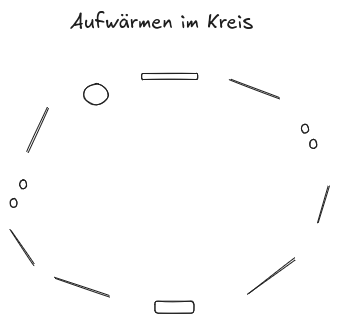
This parcours is designed as an introductory circuit for students new to psychomotor training. It emphasizes static balance, controlled movement, and confidence building. The layout encourages slow, deliberate actions rather than speed, allowing children to focus on their body’s feedback mechanisms (proprioception).
1. Who? (Target Group)
Primary: Grades 1–2 (Beginners).
Secondary: Older students requiring remedial balance training or injury rehabilitation.
Group Size: Individual execution within a class format (up to 25 students rotating).
2. What? (Activity)
A continuous obstacle course consisting of 4-5 stations that require different forms of equilibrium: dynamic (moving) and static (stationary).
3. Where? (Location)
Gymnasium: Requires a flat, non-slip surface.
Space: Minimum 10m x 10m area.
Safety: Mats should be placed under high-risk balance elements like the Rola-Bola.
4. When? (Timing)
Phase: Beginning of the “Kinder in Bewegung” program.
Duration: 15-20 minutes as part of a larger lesson, or looped for 30 minutes with variations.
5. Why? (Objective)
To establish the “Body Schema”—the internal map of the body. Children learn where their limbs are in space without looking, which is crucial for safety and complex motor planning.
6. How? (Methodology)
Circuit Mode: Students move from station to station in a set order.
Pacing: “Quality before Quantity.” Teachers reinforce slow, controlled execution.
7. Which? (Resources)
Equipment: Pedalo Classic, Balance Stones (Flusssteine), Balance Beam (turnable), and Bean Bags for sensory feedback.
The course is arranged in a circular or “U” shape to facilitate flow.
The Pedalo Start (5m)
Students begin on the Pedalo Classic.
Challenge: Ride forward 5 meters to a designated cone.
Skill: Bilateral coordination (pushing with alternate feet) and rhythmic load transfer.
The River Crossing (Balance Stones)
A series of Balance Stones arranged in a zig-zag pattern with varying gaps.
Challenge: Step from stone to stone without touching the floor.
Skill: Dynamic single-leg balance and estimating distances (spatial awareness).
The Narrow Ridge (Balance Beam)
A low Balance Beam or inverted gym bench.
Challenge: Walk heel-to-toe (tandem walk) across the beam.
Variation: Hold a bean bag on the head to enforce upright posture.
Skill: Vestibular regulation and postural control.
The Stability Stop (Rola-Bola)
End with the Rola-Bola (on a mat).
Challenge: Mount the board and maintain balance for 5 seconds without the edges touching the ground.
Skill: Core strength and rapid neuromuscular reaction.
Participating in Parcours 1 delivers specific developmental benefits explained through psychomotor science.
The Science: The vestibular system (inner ear) tells the brain where the head is in relation to gravity.
Improvement: By balancing on the Pedalo and Balance Beam, children stimulate the otolith organs. This improves their ability to maintain an upright posture automatically, freeing up brain power for academic tasks like looking at a blackboard and then down at a desk without getting dizzy or losing focus.
The Science: Proprioceptors in muscles and joints inform the brain about limb position and force.
Improvement: The Pedalo requires applying different amounts of pressure with each foot. Children learn to “modulate force”—knowing exactly how hard to push to move smoothly. This directly translates to fine motor skills, such as holding a pencil with the correct pressure (not snapping the tip).
The Science: Moving the left and right sides of the body independently but in rhythm requires communication between the brain’s hemispheres via the corpus callosum.
Improvement: The Pedalo ride forces this alternating rhythm. Improved bilateral coordination supports reading (tracking left to right) and organizing complex tasks that require sequencing.
The Science: The prefrontal cortex manages impulse control (stopping and thinking).
Improvement: The River Crossing (Balance Stones) prohibits rushing. If a child rushes, they fall off. They must inhibit the urge to run and instead plan their step. This builds executive function, helping children regulate their behavior in the classroom.
Discover our transformative educational programs that build lasting skills and confidence.