1. Who? (Target Group)
Primary: Grades 3–4.
Secondary: Any group needing team-building (e.g., after conflicts).
Format: Fixed Pairs (rotate partners halfway through).
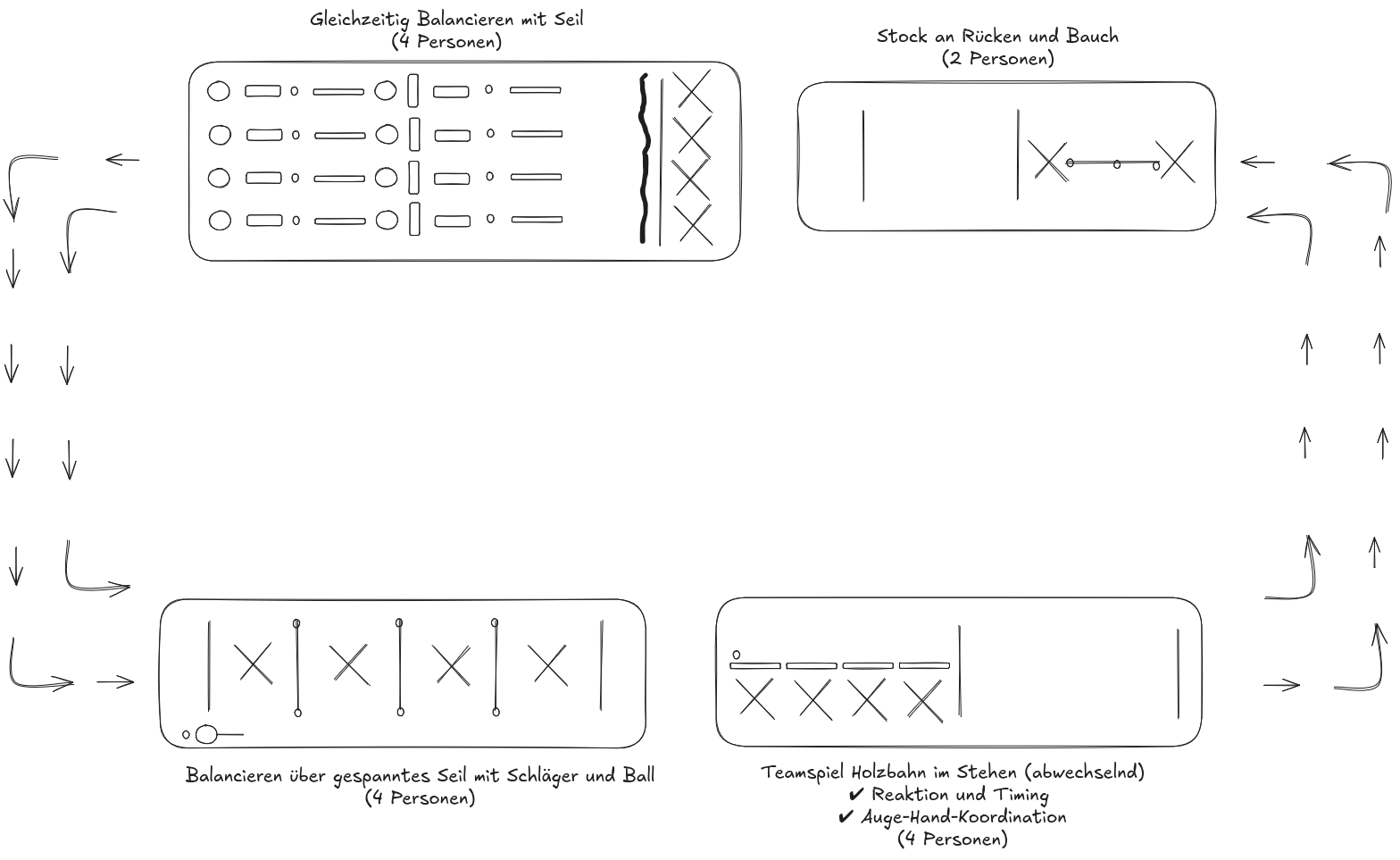
Movement is not just individual; it is social. This parcours transforms the equipment into tools for cooperation. Students must work in pairs, meaning success depends not just on their own skill, but on their ability to communicate with and support their partner.
1. Who? (Target Group)
Primary: Grades 3–4.
Secondary: Any group needing team-building (e.g., after conflicts).
Format: Fixed Pairs (rotate partners halfway through).
2. What? (Activity)
A collaborative circuit where every station requires two people to complete.
3. Where? (Location)
Gymnasium: Large open space needed for side-by-side movement.
4. When? (Timing)
Phase: Late in the program (Social competence focus).
Duration: 45 minutes (Interaction takes longer).
5. Why? (Objective)
To develop Social Intelligence. Children learn that “I can go faster alone, but further together.” It requires verbal and non-verbal negotiation.
6. How? (Methodology)
Constraint-Led Approach: “You cannot let go of the scarf connecting you.”
Reflection: “Did you lead or follow? How did you know when to start?”
7. Which? (Resources)
Equipment: Pedalo Family (or 2 Classics), Long Beam, Scarves, Balls, Sommerski.
A journey of trust and shared rhythm.
The Side-by-Side Ride (Dual Pedalo)
Two students ride two Pedalo Classics side-by-side, holding a single wooden rod or scarf between them.
Challenge: Ride to the finish line without dropping the rod.
Skill: Peripheral sensing of the partner and matching speed.
The Mirror Beam (Balance Beam)
Partners start at opposite ends of the Balance Beam.
Challenge: They meet in the middle and must find a way to pass each other without falling off.
Variation: One walks forward, one walks backward, holding hands.
Skill: Physical negotiation and support strategy.
The Team Walker (Sommerski)
The classic Sommerski (Team Skis).
Challenge: Walk a slalom course together.
Constraint: Silent round (no talking) - they must feel the rhythm.
Skill: Non-verbal communication and “group brain.”
The Trust Throw (Rola-Bola + Catch)
One student balances on the Rola-Bola, the other stands on solid ground 4m away.
Challenge: Play catch with a ball. The thrower must aim perfectly so the balancer doesn’t have to reach (and fall).
Skill: Empathy (Thrower) and Reactive Stability (Balancer).
Social movement triggers powerful evolutionary mechanisms in the brain.
The Science: Mirror neurons fire when we act AND when we see someone else act. They are the basis of empathy.
Improvement: By physically synchronizing on the Sommerski, children are training their mirror neuron system to “read” others. This biological empathy translates to better social behavior in the classroom (understanding when a classmate is struggling).
The Science: The ability to share a common point of reference with another person.
Improvement: In the Mirror Beam pass, both students must focus on the problem (the passing point) together. Joint attention is critical for group projects and understanding teacher instructions in a social context.
The Science: Nervous systems influence each other. A calm partner can soothe an anxious one.
Improvement: In the Trust Throw, the ground partner is responsible for the safety of the balancing partner. They learn that their actions (a bad throw) have consequences for others. This builds responsibility and carefulness.
The Science: Translating physical feeling into words.
Improvement: To succeed on the Pedalo, kids must say “Left, Right, Left.” They are translating motor impulses into language (Broca’s area), strengthening the connection between doing and speaking—vital for oral presentations and explaining their work.
Discover our transformative educational programs that build lasting skills and confidence.